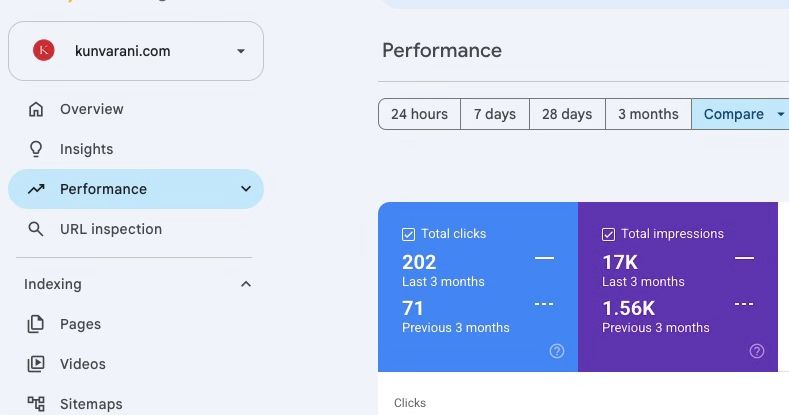
Your store earns search traffic every week — without you doing the SEO.
Sage assesses your store every week — rankings, technical health, competitor moves, AI-search citations — and does whatever will move the needle most. Some weeks that's a blog post. Some weeks it's forty product pages rewritten, or one technical fix that was quietly capping everything else. Not a fixed content quota. You approve from one dashboard — takes about 15 minutes a week.
✓ Store assessed: 42 queries, 6 pages, 3 competitors checked
✓ 1 blog post drafted → awaiting approval
✓ 12 product pages rewritten for search intent
✓ 3 broken redirects flagged for review
✓ AI search (Perplexity): cited on 5 of 14 tracked queries (+2)
✓ Weekly report sent
Your time this week: ~15 minutes of approvals.
Why organic gets skipped
The compounding months are the ones you lose first.
SEO pays off on a delay — work done in month one shows up in month six. Founders building a Shopify brand are busy with product, ads, fulfilment, everything else. The organic engine never gets started. By the time it becomes a priority, a year of compounding has already gone.
How the engine decides what to do
No fixed quota. We assess first, then act on whatever actually moves rankings.
Most SEO tools sell you a number: "2 blog posts a week," whether or not that's the right move. Sage doesn't work that way. Every week it pulls your real Search Console data, crawls your site, checks what your competitors just did, and scores every opportunity — a thin category page, a redirect chain quietly leaking authority, a keyword cluster you're about to lose, a gap a competitor doesn't cover yet. Only then does it decide what to build. Some weeks that's content. Some weeks it's a batch of technical fixes, or forty product pages that needed rewriting more than a new post did. You see the ranked list and approve it before anything runs — changes to existing pages always wait for your sign-off; brand-new pages with nothing to compare against are optimised on first pass since there's no prior version to approve against.
What Sage does
Content, technical, and product — pulled on whichever lever moves the needle.
✍️
Content SEO
Blog posts written in your brand voice when content is the highest-priority move that week — not a fixed quota you pay for whether it's needed or not
Each post targets a specific keyword your customers search for
FAQ schema injected automatically — not for Google's old rich-result snippet (that benefit was restricted in 2023), but to make your content easier for AI answer engines to parse and cite
Built to rank on Google and get cited in AI answers (tracked via Perplexity)
Topic clusters planned across your full keyword map — not random posts
Every post sits in your portal for approval before it goes live
Reject with a note and it rewrites to your feedback — no back-and-forth email
⚙️
Technical SEO
Weekly audit of every page — title tags and meta descriptions
Rewrites queued for your approval, then pushed directly to your Shopify store
Broken redirect chains detected and flagged for review
Internal linking built into every new blog post
FAQ schema markup added to blog posts
Issues that need a developer (image compression, JS bundles) are listed clearly in your portal — we don't pretend we can fix those
🛍️
Product pages
Every product page mapped to its target search query and optimised for it
New products optimised as they're added — not in a quarterly batch
Collections and category pages given proper H1s and introductory copy
The playbook updates itself
When SEO changes, Sage's rules change — before it touches your store.
Every week, Sage scans SEO and AI-search sources for changes worth acting on — an algorithm update, a schema strategy that stops working, a new pattern in how AI answers cite sources. Each finding becomes a proposed rule change, reviewed by a human before it's approved. Once approved, it applies across every client automatically — your strategy doesn't run on last year's assumptions.
What we don't do
Better to be honest than to over-promise.
These are real limits — we flag them because finding out six months in is worse.
✕
Paid adsSage is organic only. We don't touch Google Ads, Meta Ads or any paid channel. SEO and paid search are different disciplines — we do one well.
✕
Image compression and site speed codeWe flag speed issues in your portal and tell you exactly what to fix, but optimising images, reducing JS bundle sizes, and removing render-blocking CSS requires a developer. We tell you what, not how.
✕
Social media managementWe write content for search, not for Instagram or TikTok. Some posts get repurposed for social, but social strategy isn't part of this.
✕
Guaranteed rankingsNo one can guarantee a position. We guarantee the work runs every week, the audits are honest, and you can see exactly what's happening. Results compound — the engine doesn't stop.
✕
Link buying or black-hat tacticsEvery backlink we pursue is editorially earned — pitching real journalists and bloggers. We don't buy links, join link farms, or do anything that risks a Google penalty.
✕
Results in week oneSEO compounds. The first month is onboarding, mapping, and laying foundations. Meaningful organic growth typically shows up around month three. We're honest about this on every weekly report.
How it works
You stay in control. Sage does the work.
Week 0
Onboarding
We learn your brand voice from your own content, connect your store and GSC, and begin mapping your pages to the search queries they should win.
Every week
Sage assesses, then acts
Real GSC data, a site crawl, and a competitor check get scored into ranked opportunities. Whatever ranks highest gets built — a post, a page rewrite, a technical fix — without you having to decide or manage it.
15 min / week
You approve
Everything queues in your portal. Approve, reject with a note, or read your weekly report. Nothing ships without your sign-off.
Backlink outreach & your Gmail
Sage drafts. You send. Nothing goes out on its own.
Part of Sage's job is finding sites that should link to yours and writing the pitch. That email has to come from you, not a bot — so Sage requests Gmail's compose-only permission (gmail.compose) to place the pitch directly in your own Gmail drafts folder. Sage cannot read your inbox, cannot send on your behalf, and cannot see any other email in your account. You open the draft, edit it if you like, and press send yourself. Revoke access any time from your Google Account permissions — Sage stops drafting immediately, nothing else changes.
Your approval portal
One place to see and approve everything.
Every opportunity Sage finds — a post, a page rewrite, a technical fix, an outreach pitch — waits in a ranked queue for your approval before it goes live. You see the evidence behind each one, not just a black-box result.
OpportunitiesBlog postsPage changesProgress
Rewrite 12 product pages losing rank to a competitor's new category page
Type: page_rewrite · Priority: high · Evidence: 3 keyword clusters dropped 4+ positions in 28 days
Approve →Reject with note
The Complete Guide to Salwar Kameez for Weddings Abroad
Type: content_gap · Keyword: salwar kameez for wedding guests UK · 1,240 words · Ready for review
Approve →Reject with note
Early access
We're building with a small first cohort.
Sage is new, and we're upfront about that. Early clients get direct access to the founder, weekly reports that show real numbers (not dashboard screenshots), and pricing that reflects the stage we're at. We don't have ten case studies yet — we have one client, and we're building the next few. If you want proof of results first, check back in a quarter. If you want to be part of building something serious from the start, this is that call.
Pricing
One plan. Flat monthly. No contracts.
Every client gets the full engine — content, technical, product pages, and outreach, assessed and ranked weekly. No tiers, no feature gating. First month is discounted so you can see the reports land before committing at full price.
Full engine
Sage
First month: $450 — then $750/mo
$750$450/mo
Everything Sage does, for every client — nothing held back for a higher tier
Full weekly assessment across content, technical, product, and outreach — every lever scored and ranked
Sage acts on whatever moves the needle most that week: content, page rewrites, technical fixes, or outreach — not a fixed post quota
Keyword research and topic cluster planning
FAQ schema on every post
Weekly technical audit — title tags, meta descriptions, redirect chains flagged
Product pages kept optimised as your catalog grows
AI-search citation tracking (Perplexity)
Developer recommendations listed clearly — what needs code, what doesn't
Weekly performance report with real impressions data
Client approval portal — approve or reject with a note